Confidence Doesn't Erode, it Goes Out Of Date.
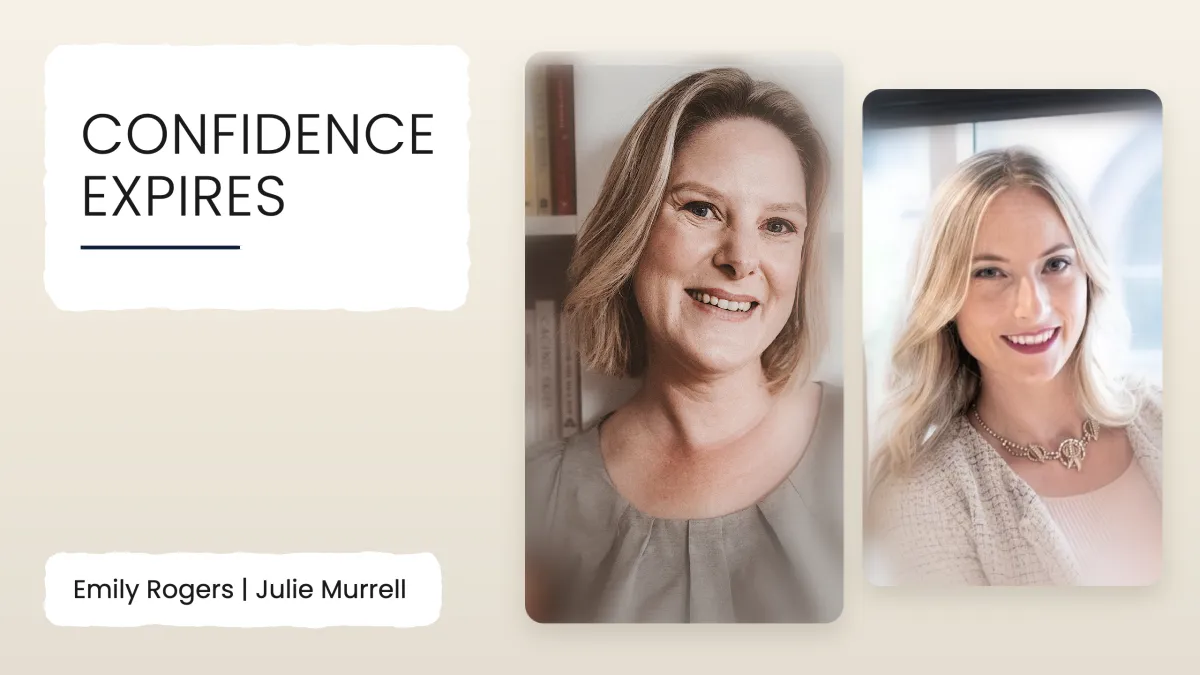
I sat down last week with Julie Murrell, a style consultant who works with women on how they show up, to record a conversation about confidence.
We had planned to talk about erosion. The way confidence seems to thin out for women somewhere in their forties, so gradually that nobody can name the week it started.
Partway through, I stopped, because erosion isn't what I actually see.
What I see is confidence that has gone out of date.
You built it for a woman who no longer exists
Most of us set our goals young. In our twenties, sometimes earlier. We chose a direction, a career, a picture of the life we wanted, and then we built ourselves to match it.
The building worked. You got good at the thing. You were promoted, or you started something of your own, or you raised a family in a country that wasn't yours. The confidence was real, and it came from doing hard work and doing it well.
Then life kept going. You got married, or you didn't. You had children, or you didn't. You moved. Your parents aged. Your priorities rearranged themselves without asking permission.
You changed. The goals stayed exactly where you left them.
So the confidence is still there. It just belongs to a woman who doesn't exist anymore.
And many women don't discover this until they arrive. They reach the role, the title, the business they set out to build, and they get there, look around, and think: is this it?
Resilience is not the answer to this one
The women this happens to are, almost without exception, extremely resilient. They have got through genuinely hard things. Redundancies, relocations, illness, businesses that failed and businesses that worked.
That is exactly the problem.
Resilience gets you through. It does not get you through with yourself intact. You can push through a decade of change, handle every bit of it, arrive on the other side, and still not know who you are or what you want next.
Getting through and getting through as yourself are two different achievements, and we only ever teach women the first one.
What sits underneath is a different skill, and the piece of it that matters most here is the ability to stay anchored to your own values and identity while everything external shifts. It is the opposite of being defined by your title, your location or your role. When it is working, you stay recognisable to yourself through the change. When it isn't, you come out the other side accomplished and unfamiliar.
What it looks like from the inside
Because the drift is slow, you don't see the confidence going. You see the symptoms.
You stop putting your hand up. Someone asks who wants to lead the presentation and you hear yourself say that so-and-so would probably be better.
You read a job description and eliminate yourself before anyone else gets the chance. I had a client with two decades in her industry, already at the top of what she did, who turned to me in a session and said she didn't have the piece of paper. Nobody had asked her for a qualification. She had ruled herself out on her own.
You speak to the people closest to you with an edge that isn't like you. When I was living in Taipei I found myself shouting at my daughter over spilled milk, and it was the fear in her face that made me realise it had been going on for a while.
On the outside, everything was fine. Good friends, long walks, good holidays. I was happy and I was not aligned, and those two things can sit in the same woman at the same time.
That is what makes this so hard to catch. Nothing has gone visibly wrong.
Amy makes it all sound sensible
I call the amygdala Amy. She's the voice that gets loudest when you're doing the most meaningful work, and she isn't a character flaw. She's doing her job, which is keeping you exactly where you are, because where you are is known and known feels safe.
What surprises most of my clients is that Amy rarely shouts. She gets reasonable.
Not this year. Wait until things settle down. You've got far too much on. You'd want to think about it properly and you haven't the time.
That's the dangerous version. Not panic. Plausibility.
Where to start, and where not to
Almost everyone wants to start with a plan. It's too early for a plan.
Start with strengths. This is where I begin with every client, and I was genuinely surprised to find that Julie begins in the same place, because she's working on the outside and I'm working on the inside. She asks women what they love wearing, what they feel good in, what they want to convey. I ask what they're good at, what people come to them for, what they'd do without being asked.
Both of us then watch capable, accomplished women argue their way out of the answer.
Is that really a strength, or is it just a skill? Other people are better at that than me. It comes so naturally I don't even have to think about it, so it can't count.
That's Amy again, and this is why it's genuinely difficult to do alone. Complex transition is not a thinking problem you can solve in your own head. The right room matters, which is why women who move through change well tend to be the ones who deliberately put themselves among other thoughtful people who understand the terrain. That isn't an optional extra. It's part of the skill.
The other part is patience, which nobody wants to hear. Clarity doesn't arrive on demand. You take one honest step, and the next one shows itself, and the one after that. It almost never comes during the hard conversation. It comes the morning after.
Nothing has gone wrong
This is the thing I most want you to take from the conversation.
It's a normal stage.
We track our children's ages and stages without a second thought. First words, first day of school, all of it, and we never once suggest that a child is failing by growing. We simply don't do the same for ourselves. So when this arrives, women assume they have made a wrong turn somewhere, and they haven't.
You haven't made poor choices. You haven't wasted twenty years. You have changed, which is the only thing anyone was ever going to do, and the goals you set at twenty-eight were never going to keep up.
What comes next isn't a plan. It's a question, held lightly. Am I showing up the way I want to? Take it for a walk, or sit in the sun with it and a cup of tea, and give it enough room to answer.
Then start with your strengths.
Connect with Julie:
Email: [email protected]
Substack: https://open.substack.com/pub/themindfuldresser
LinkedIn: https://www.linkedin.com/in/julie-murrell-style-coach/
Instagram: https://www.instagram.com/science.of.image/
The next LeadHer Circle begins on 22 October 2026. It runs for six months, online, with a small group of senior women working through exactly this alongside each other. I'm choosing the group through September and closing conversations at the end of the month.
If you read this and recognised yourself, come and have a conversation with me. https://links.ivorey.io/widget/bookings/theleaptolead-discovery